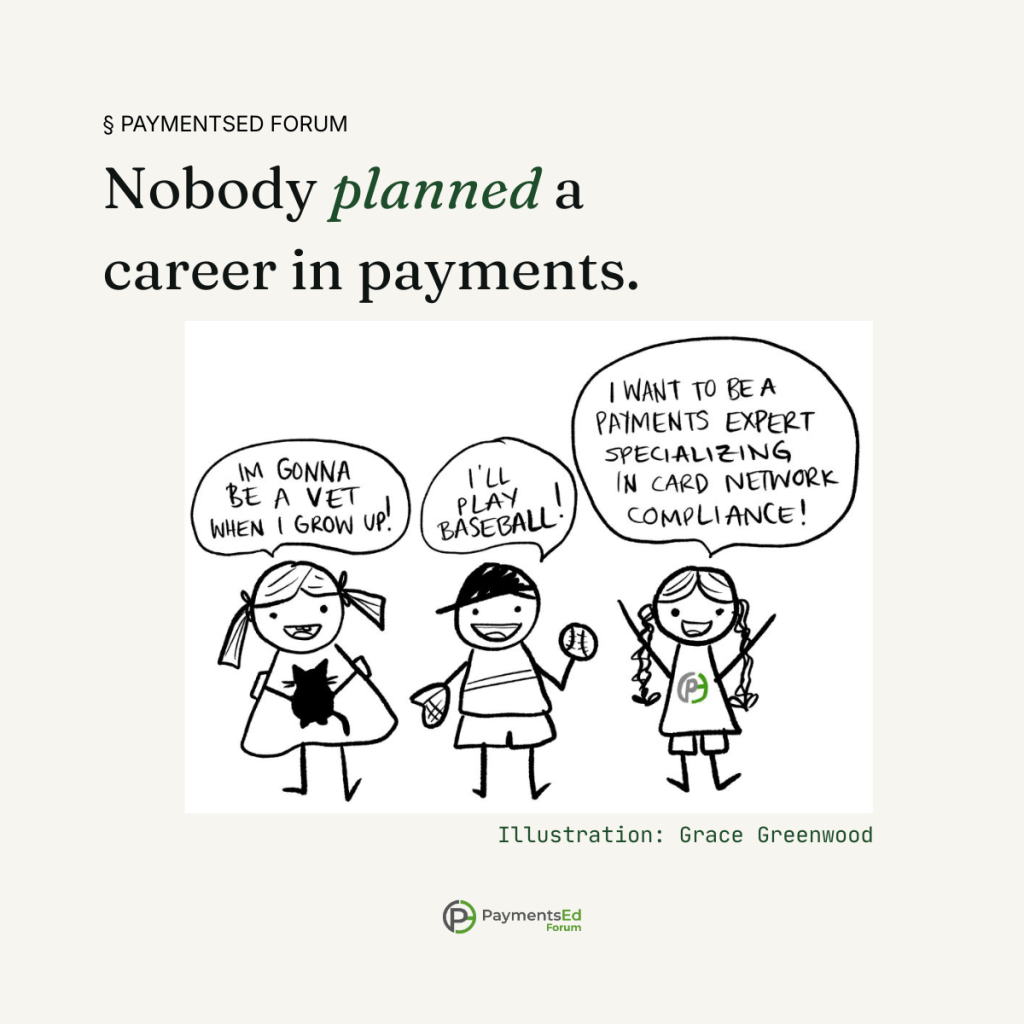
Payment processing probably wasn’t your childhood dream. But then you got hooked. The complexity, the constant evolution, the smart people tackling hard problems. And at some point, you realized: there’s no obvious degree for this. No “Bachelor of Science in Authorization Rate Optimization.” No “Master of Chargeback Representment.”
So where do payments professionals actually go to learn? Three paths have emerged: focused FinTech master’s programs, industry credentials, and practitioner communities like PaymentsEd.
FinTech Master’s Programs (The Closest to a Payments Degree)
Several universities have built dedicated Master of Science in Financial Technology programs. Unlike traditional finance degrees that focus on portfolio management or investment banking, these programs dedicate significant curriculum to digital payments, payment rails, blockchain, and transaction risk.
Duke University (Master of Engineering in FinTech)
For those who lean toward the technical, architecture, or product side. Duke’s MEng in FinTech is an engineering-focused master’s (available online or on campus, 12-29 months) that explores how payment protocols, digital wallets, smart contracts, and fraud analytics work under the hood. The distinction matters: MBAs focus on management and strategy; this program focuses on building, deploying, and architecting financial systems. Courses cover blockchain, cryptocurrency, digital assets, AI/ML in finance, and quantitative analysis. Alumni land at firms such as Goldman Sachs, JPMorgan Chase, Capital One, and DTCC.
University of Colorado Denver (MS in FinTech)
A 30-credit-hour program (Colorado’s first MS in FinTech) that combines finance, information systems, data analytics, and project management. Available fully online, with fall, spring, and summer start terms. No GMAT/GRE required for students with a 3.0+ GPA. The curriculum covers blockchain, AI, big data analytics, and financial software, with access to 16 Bloomberg Terminals and a world-class commodities trading lab. Industry partners include Robinhood, JPMorgan Chase, Janus Henderson, Charles Schwab, and Morgan Stanley. Designed as “zero-to-tech friendly” for professionals building confidence from the ground up.
Keiser University (MS in Financial Technology)
A 100% online program covering digital payments, marketplace lending, cryptocurrency, blockchain, data analytics, AI/ML in finance, and fintech law and policy. The program emphasizes hands-on experience with real financial tools and programming languages. Courses include Data Analytics, AI and Machine Learning in Finance, Digital Payments and Marketplace Lending, Cryptocurrency and Blockchain, Data Visualization, Fintech Law and Policy, and Financial Security.
Kennesaw State University (MS in Digital Financial Technologies)
The only graduate fintech degree in Georgia, positioned in the state’s “Transaction Alley,” home to 200+ fintech companies where more than 15 million global card-enabled merchants rely on Georgia-based processors. This 100% online, 30-credit-hour program can be completed in one to two years with fall, spring, and summer entry terms. No GRE or GMAT required. The curriculum focuses on AI, data, digital payments, product management, risk and compliance, and digital transformation. Graduates are prepared for roles in product management, strategy and innovation, data analytics, risk and compliance, consulting, and operations.
Industry Credentials That Carry Weight
Traditional academia has been slow to keep pace with payments infrastructure. The most recognized credentials in the industry come directly from electronic payment associations and professional organizations. In the eyes of payment processors, card networks, and fintech employers, these intensive programs often carry as much weight as a university diploma:
Nacha AAP and APRP
The Accredited ACH Professional (AAP) and Accredited Payments Risk Professional (APRP) designations are widely considered the benchmark for mastery over the operational and regulatory mechanics of electronic payments. If you work in ACH, these are the credentials that matter.
CTP (Certified Treasury Professional)
Administered by the Association for Financial Professionals (AFP). The CTP credential covers cash management, treasury operations, and corporate finance, with significant overlap into payment operations. Maintaining it requires ongoing continuing education credits, which is one reason practitioners attend events like the PaymentsEd Forum (approved for up to 16.4 CTP recertification credits).
CFE (Certified Fraud Examiner)
Administered by the Association of Certified Fraud Examiners (ACFE), the CFE credential covers fraud prevention, detection, and investigation. For payments professionals working in fraud operations, risk management, or chargeback teams, the CFE provides training in complex financial transactions, investigative techniques, legal issues, and anti-fraud program design. The ACFE has over 95,000 members across nearly every sector and industry globally.
Practitioner Communities
Here’s the reality: the majority of people working in payments never studied it in school. There was no payments major. Most professionals landed in the industry sideways, from finance, IT, operations, or customer service, and learned by doing. That means the most valuable education in this field doesn’t come from a lecture hall. It comes from the person sitting next to you at a conference who solved the same problem you’re facing, six months ago, at a company twice your size.
Hallway conversations, merchant-only roundtables, and peer relationships built over years of showing up to the same room: that’s how payments knowledge actually transfers. Credentials validate what you know. Communities teach you what you don’t.
PaymentsEd exists for exactly this. A 501(c)(6) non-profit founded in 1989, run by a volunteer merchant-led board. No corporate parent, no vendor agenda. The organization is built on three principles: practitioner-led education (sessions taught by the people running payments, for the people running payments), a working community (year-round merchant and advisor connections that outlast any single event), and volunteer leadership (a board that commits hours to shaping the agenda and keeping the programming independent).
The Annual Forum brings hundreds of payments professionals together each year, from seasoned leaders to emerging operators, across digital, omnichannel, mobile, and physical point-of-sale environments. Free webinars run year-round. CTP recertification credits are available. And the conversations that happen between sessions, at the Networking Hub, over coffee, in the hallway, are often where the real learning happens.
PaymentsEd serves the people who learned payments on the job and want to keep getting better at it alongside peers who understand the work.
What Actually Matters for Your Career
The payments industry values demonstrated knowledge and peer credibility over diplomas. A CTP, AAP, or CFE credential, combined with active participation in practitioner communities, signals more to a hiring manager than a generic MBA. The FinTech master’s programs are valuable if you’re entering the field or pivoting from traditional finance, but for working professionals already in payments, credentials, and community tend to deliver more per hour invested.
The common thread across all three paths: payments is learned by doing, and refined by learning from others who are doing it at scale.
The 2026 PaymentsEd Annual Forum is in Boston this July. Three days of practitioner-level sessions, 16.4 CTP credits available, and the people who run payments at the companies you read about. Save the date for the 2027 Forum.